
On 11 December 2025, the Company announced that it had executed an agreement to earn up to a 90% interest in the Gold Point Project, located in the Tier-1 mining jurisdiction of Nevada, USA. This acquisition marks the first time in 140 years that the historic Gold Point mining district has been consolidated under a single owner.
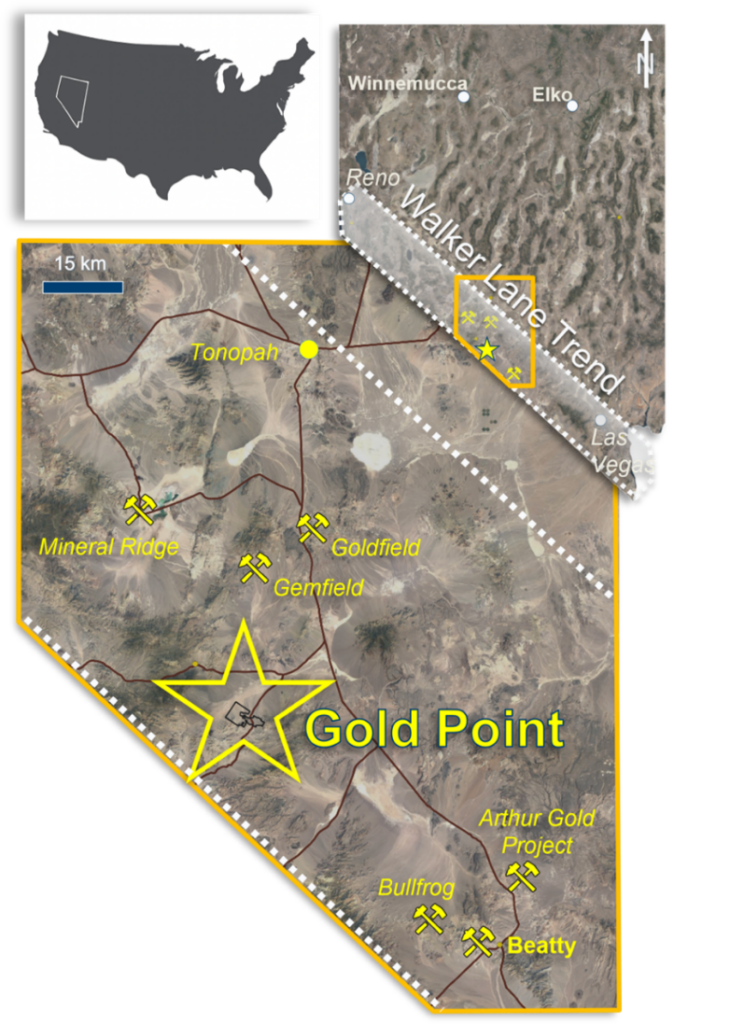
Gold Point Project is located in Western Nevada approximately 90km south of Tonopah along US Highway 95, within the highly prospective Walker Lane District (Figure 1).
The Project consists of 195 federal lode claims and 7 patented lode claims near the historic mining town of Gold Point. The Project sits within an area boasting an estimated regional endowment of 40Moz Au and 205Moz Ag, including the world-class deposits at Goldfield (4 Moz Au), Bullfrog (6 Moz Au), and AngloGold Ashanti’s 16 Moz Arthur Gold Project (70km south of Gold Point).
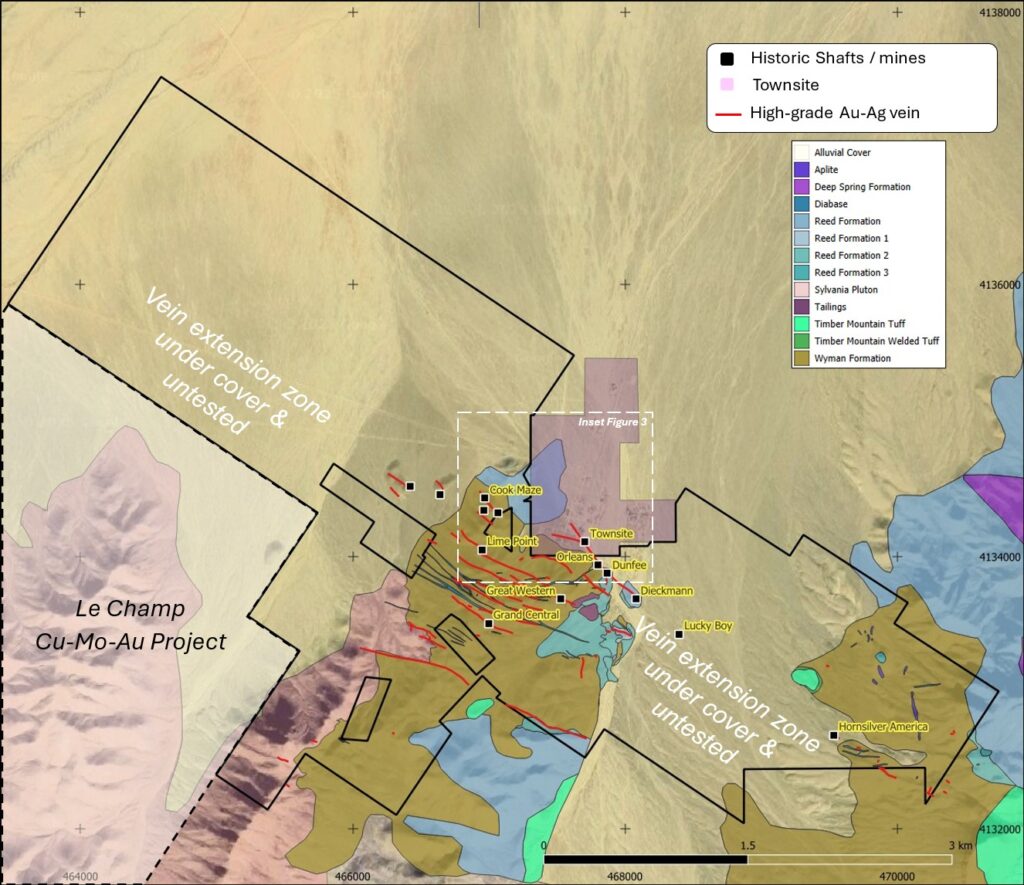
Historically mined high-grade gold-silver mineralisation is largely developed within Neoproterozoic metasedimentary rocks of the Wyman Formation. These mineralised veins extend east and westeward from the historic mines for over 2km along strike, where they appear to continue under alluvial cover (Figure 2).
In the southwest of the Project area, newly discovered Mid-Jurassic intrusive rocks of the Sylvania Plutonic Complex host extensive Copper-Molydenum-Gold porphyry mineralisation. This was never recognised by miners in the district, and represents a new critical minerals targets for the Company. Similarly, Gold-Copper-Tungsten skarn mineralisation has been identified proximal to the contact of Wymann and Sylvania complex rocks, but remains untested.
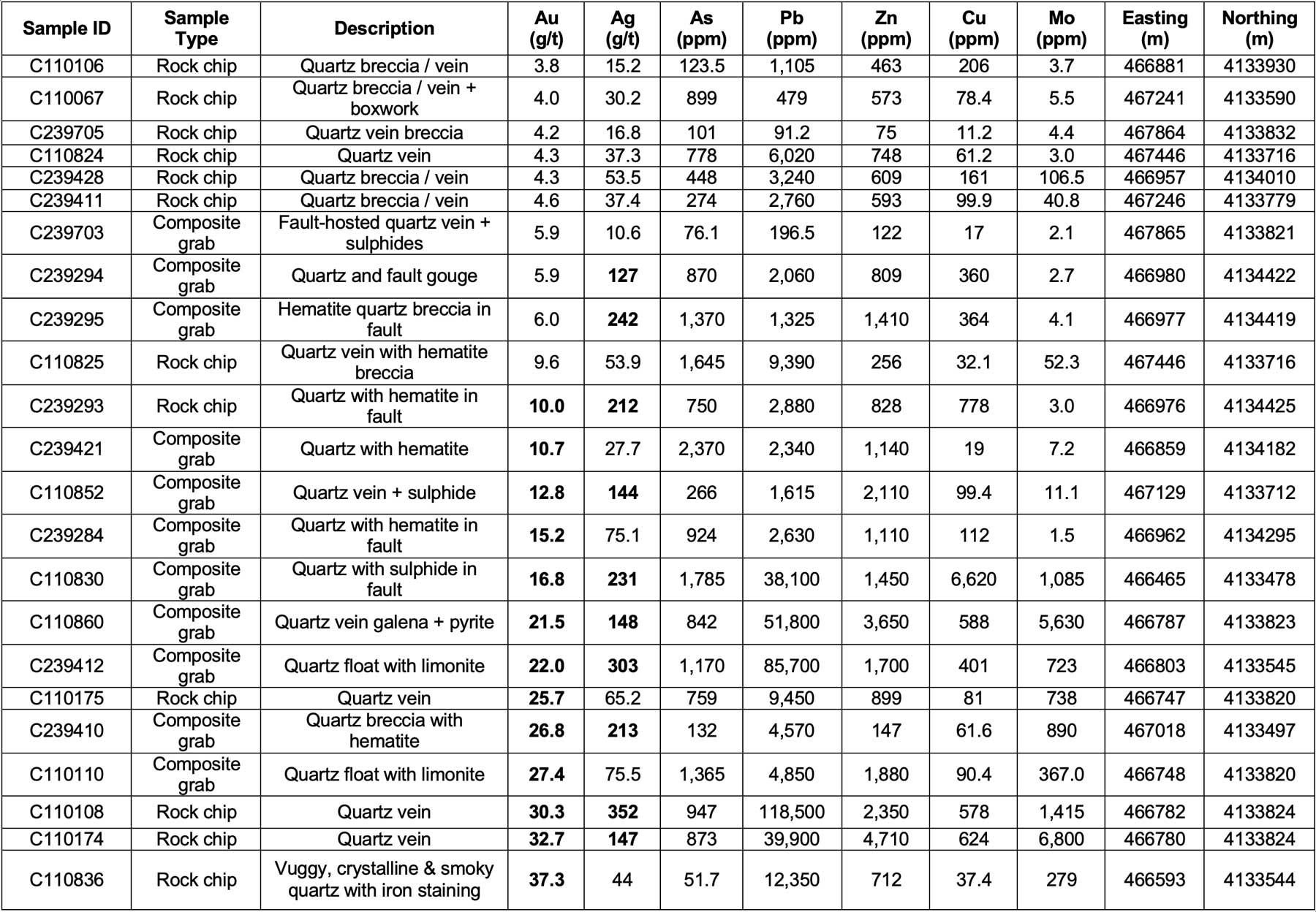
Previous reconnaissance surface sampling has confirmed high-grade gold-silver mineralisation in several of fault-breccia veins throughout the claims (Figure 4). In a 2km2 area over the historic Orleans, Great Western, Grand Central and Lime Point Mines, 56% of samples collected returned results >10 g/t Au (Table 1).
Collectively, the geological architecture and distribution of various mineralisation styles at Gold Point indicates a large, potentially integrated magmatic-hydrothermal system. Given Nelson’s consolidation of historically fragmented claims in the District, a camp-scale mineral-systems exploration approach can for the first time be applied.
Nelson is currently focussed on defining the potential scale of mineralisation within the immediate Great Western, Grand Central and Orleans historic Mine areas, and will utilise that knowledge to test the broader Gold Point area. As such, a two-stream work program is currently being deployed by the Company:
1. At the mine-scale at the Orleans and Great Western vein systems, the Company is planning to undertake the following:
- Underground multi-spectral and LiDAR survey;
- Systematic channel sampling and multi-element geochemical analysis throughout the underground workings;
- Geophysical surveys – likely magnetics and Induced Polarization (IP); and
- Contingent on accessibility, drilling of targets identified in the geochemical and geophysical work.
2. At the claim package-scale, the Company will undertake:
- Surface geological and structural mapping;
- Multi-element geochemical rock chip sampling;
- Geophysical surveys to infill coarse-spaced historic airborne data; and
- Priority target generation for drill testing.
The overall objectives are to integrate underground and local surface geological, geochemical and geophysical data to develop a mine-scale 3D structural and lithogeochemical model. This knowledge will then be used to better-define targets within the Orleans and Great Western vein systems, which are expected to be drill-tested from potential underground positions.
In addition, the structural and lithogeochemical model will be applied at claim-package scale to refine priority targets for prompt drill testing.
Intrusion-hosted and related Gold-Silver Results
On 18 February 2026, the Company reported results from an additional seven rock chip assays at Gold Point. Five were taking from quartz veins within the Sylvania Intrusive Complex rocks, and two of skarn-type mineralisation. The results confirm that the Sylvania Intrusive Complex hosts high-grade gold-silver mineralisation over 2.5km southwest of the historic mines at Orleans, Grand Central and Great Western. Mineralisation in the historical mines is hosted in WNW-striking mineralised structures in Neoproterozoic rocks of the Wyman Formation.
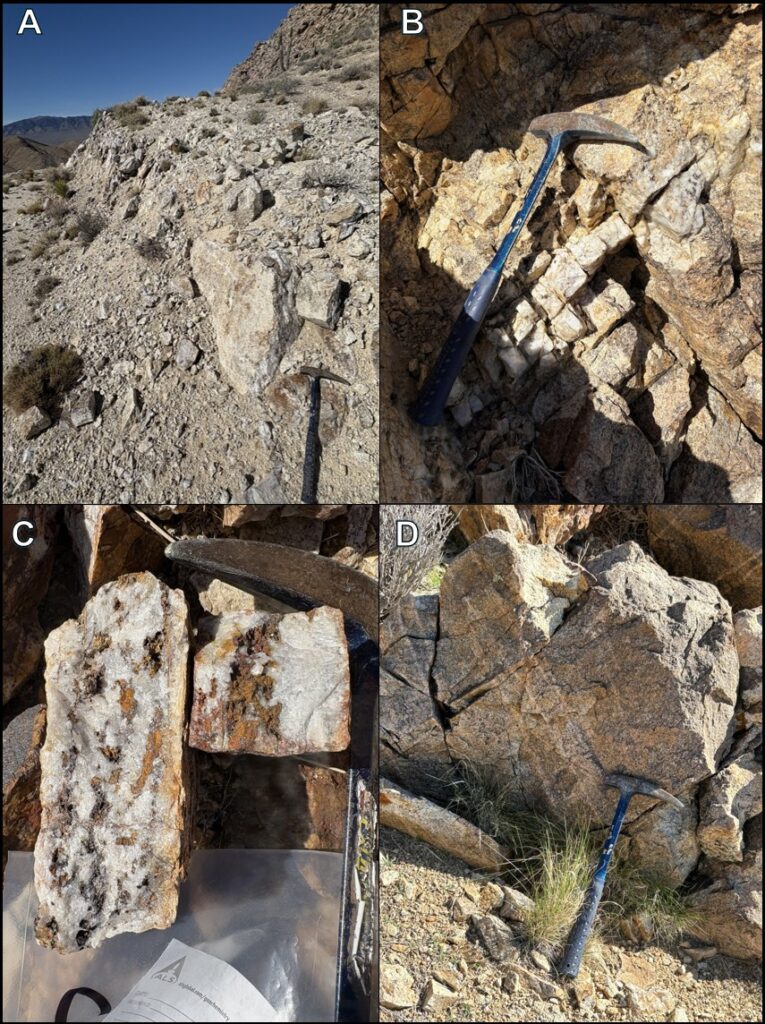
An extensive quartz stockwork zone occurs within the granite ridge, with collected vein samples returning spectacular grades of 15.1g/t Au and 32.4g/t Ag (sample C239875; Figure 3). In addition, coarser sheeted quartz veins up to 15cm thick occur adjacent to the stockwork zone, with sample C239876 returning 13.8g/t Au and 357g/t Ag (Figure 3). Importantly, these samples also contain elevated As, Bi, Mo, Te, and W, common indicator elements for intrusion-related systems.